Femtosecond laser breaching, Raman Imaging, nanomanipulation BioWorkstation
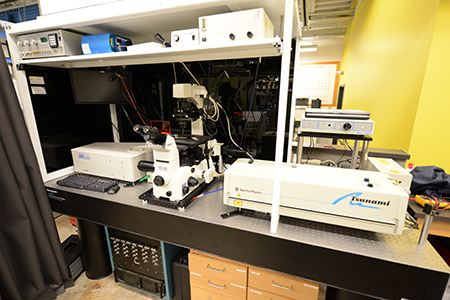
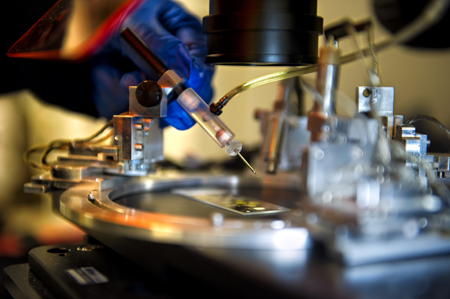
Our lab has developed a nanomanipulator equipped with four positioners that can be fitted with micro-tweezers, electro-grippers, glass capillary tips, and/or quartz rods. A single joystick with X, Y, and Z directional control, operates all of the positioners individually, with 100nm resolution in coarse mode and 5.4 nm resolution in fine mode. The nanomanipulator is mounted to an inverted Nikon TE2000-U microscope with 10x, 40x, and 100x objectives, which is equipped with a C-HGFI fluorescence source for fluorescence microscopy. A temperature and CO2 gas controlled incubator provides the ideal environment for incubation of cell cultures atop the microscope stage. A four-channel nitrogen gas pressure injector is coupled to the nanomanipulator to provide pipetting function for capillary tips. The capillary tips and rods fitted to the probers are composed of either quartz or glass and are pulled on-site with the use of a CO2 laser allowing for custom diameter sizes as small as 500 nm.
Raman microscopy is a non-invasive method cable of identifying and providing spatial resolution of biological molecules within a single cell, either living or fixed. Raman microscopy provides the location of a chemistry of interest within a cell allowing for a precise extraction of that chemistry with the nanomanipulator for analysis via mass spectrometry thereafter.
The ultrafast titanium-sapphire laser incorporated into the bioworkstation has a full tuning range of 780- 820 nm, a 30 femtosecond laser in pulse width, and an average power of 4.0W at 800nm with a pulse energy of 5nJ. Ultrafast lasers can create sub-micron dissections in plant and mammal cells without inducing shock or thermal pressure to the sample or causing the distress response which can cause necrosis. This laser will be used to perform cellular nanosurgery, followed by extraction of targeted organelles with the nanomanipulator afterwards for a minimally invasive technique providing localized chemistry of in vitro cell cultures.