Direct Lipid Analysis with Nanomanipulation Coupled to Mass Spectrometry
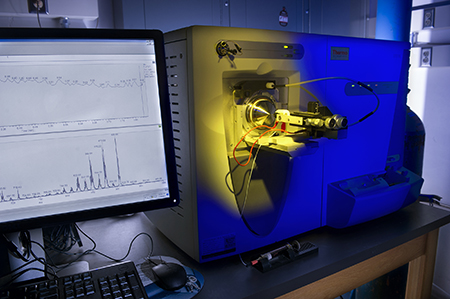
Lipids are a vast class of biological molecules that are responsible for structure, signaling, transport, and energy within biological systems. Lipids also consist of many different classes including, but not limited to, free fatty acids, sterols, glycerolipids, and phosphoglycerolipids. Previous methods of lipid analysis on biological systems have used total lipid extractions involving organic solvents and multi-step purification methods to remove non-lipid contaminants. The purified total lipid extract is then subjected to separations through HPLC or GC before mass spectral analysis. However, when extracting lipids on a single cell scale sample volumes are around 10μL, thus, multi-step extraction and chromatography separation is not feasible. Therefore, the lipid extraction needs to be a single step, have a solvent system that will produce a sample purified enough for direct inject and be able to solubilize a charge carrier, and provide lipid class-specificity.
Our group has recently evaluated traditional extraction solvent systems to identify systems that have a high affinity for specific lipid classes. Eight lipid standards representing eight lipid classes were used to evaluate nine solvent systems. Lipid extractions were analyzed using ESI-MS and scored based on the relative intensity of the lipid standard peak in the mass spectrum. The results were tabulated to present both total extraction scores and lipid class-specific scores to be used as a reference for solvent selection when extracting specific lipids from biological samples.