Rapid Illicit Drug Development and Characterization
Analogs of controlled substances are a major source of disagreement in the legal community. The analog statute of the Controlled Substances Act criminalizes any analog which has a structure or effect that is “substantially similar” to a scheduled drug. This vague terminology allows for much debate in a courtroom – what is “substantially similar”? In the justice system, conviction or acquittal in cases of analogs of scheduled drugs often comes down to the testimony of a scientist on similarity of structure or efficacy. Comparison of structures can be problematic because opinions differ on what qualifies as “similar enough.”
To circumvent this problem, one-pot synthesis techniques are being developed which will provide mixed products of many potential drug analogs for characterization in a more meaningful way. These potential analogs are structurally characterized via electrospray ionization – mass spectrometry and collision induced dissociation (CID) prior to further investigation of their effectiveness as drugs. The structures and fragmentation patterns are then entered into a searchable database (ACD Labs) which could potentially be adapted for a web portal available for criminal investigation labs.
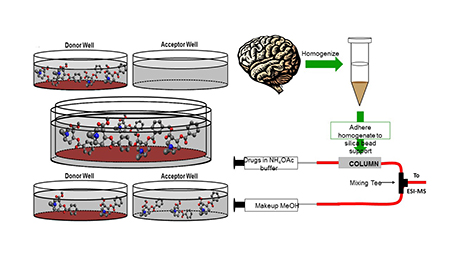
By using a parallel artificial membrane permeability assay for the blood-brain barrier (PAMPA-BBB), the BBB permeability of these synthesized compounds can be determined. By using two 96-well plates sandwiched together and separated by porous PVDF membranes coated in a phospholipid mixture, drug diffusion from the top well to the bottom well is measured by dilution and ESI-MS analysis. This is valuable information to have because psychedelic or mind-altering drugs must access receptors in the brain in order to behave similarly to currently scheduled drugs.